[Grant Request] AlphaYields — ayETH built on rETH: net-new, delta-neutral rETH demand across chains
Applicant: Filipe — Founder & Lead Strategist, AlphaYields (with Bogdan Ivaniuk, Co-founder & CTO)
Amount requested: $30,000
Commitment: ayETH live on mainnet with rETH as its base asset within 3 weeks of grant approval
Category: Grant — rETH adoption / ecosystem integration
Summary
AlphaYields is requesting a $30,000 grant to make rETH the base asset of ayETH, our ETH-denominated yield product, with a commitment to ship it live within three weeks of approval.
What we’re underwriting is net-new, price-insensitive demand for rETH and sticky liquidity — demand that comes from users depositing ETH into a yield product and the strategy accumulating rETH underneath, rather than from users choosing to stake directly. This is the model we’ve now run with three ecosystems, each negotiated directly with the chain to grow adoption of their LST. We want Rocket Pool and rETH to be the next.
Everything technical below is measured on-chain over a full year, not quoted from dashboards: the rETH yield is reconstructed from 366 daily archive reads of the exchange rate, the Aave borrow rate is read from the V3 Pool at the same blocks, redemption liquidity from the Rocket Pool deposit pool contract, and funding from 8,760 hourly Hyperliquid prints. No centralised-exchange data or account is used anywhere in the construction.
About AlphaYields
AlphaYields is the Yield Layer of DeFi — a chain-abstract protocol that packages conservative, real-yield strategies into single-deposit ayTOKENs. We never take custody, and we compute APY from on-chain share-price history only.
Each ayTOKEN is a portfolio of DeFi strategies: a user deposits one asset and the protocol runs, rebalances, and hedges the underlying positions. The adoption insight behind all of it — users don’t want to manage LSTs, leverage, or hedges. They want to deposit and hold a token that goes up. When the product holds the LST as its base asset, LST adoption scales with deposits, without asking any user to convert or stake anything.
Track record: the ecosystem LST playbook
We partner directly with each ecosystem so that our product becomes the adoption engine for their staking token and a source of sticky liquidity:
- Flow — ayFLOW (live since Sept 2025): drove staked-FLOW adoption 3–4× above the ecosystem’s prior baseline, purely through product deposits. No user had to learn staking mechanics — the strategy sourced and held the LST as it deployed capital.
- Katana — ayKAT (live): KAT-based yield driving adoption of avKAT, the staked version of KAT.
- Polygon — ayPOL (coming soon): the same construction applied to POL.
Each of these was negotiated with the ecosystem specifically to bring their LST adoption up and lock in sticky liquidity. Rocket Pool + rETH is the natural next partner — a larger, more liquid market than any of the above, and one where the delta-neutral construction below is fully verified on-chain.
The strategy, and how each claim was verified
We assessed five constructions on rETH. Two are deployable, one is an overlay, one is set aside, and one is the reference floor:
| Strategy | Denomination | Net APY | Capacity | Verdict |
|---|---|---|---|---|
| Funding carry — hold rETH, short ETH perp | USD | 6.3% (365d) · 7.7% (90d) | $390M+ | Deploy |
| GMX ETH-USDC pool + hedge | USD | 5.9% (2026) · 17.6% (full window) | $20–50M | Deploy |
| Secondary-market arbitrage overlay | USD | +0.5–2% on top (est.) | scales with the above | tick-level analysis required |
| rETH looping on Aave (4×) | ETH | 2.5% — leverage adds +0.3pp | $78M | not worth the leverage |
| Hold rETH (reference) | ETH | 2.26% | $1.3B | floor |
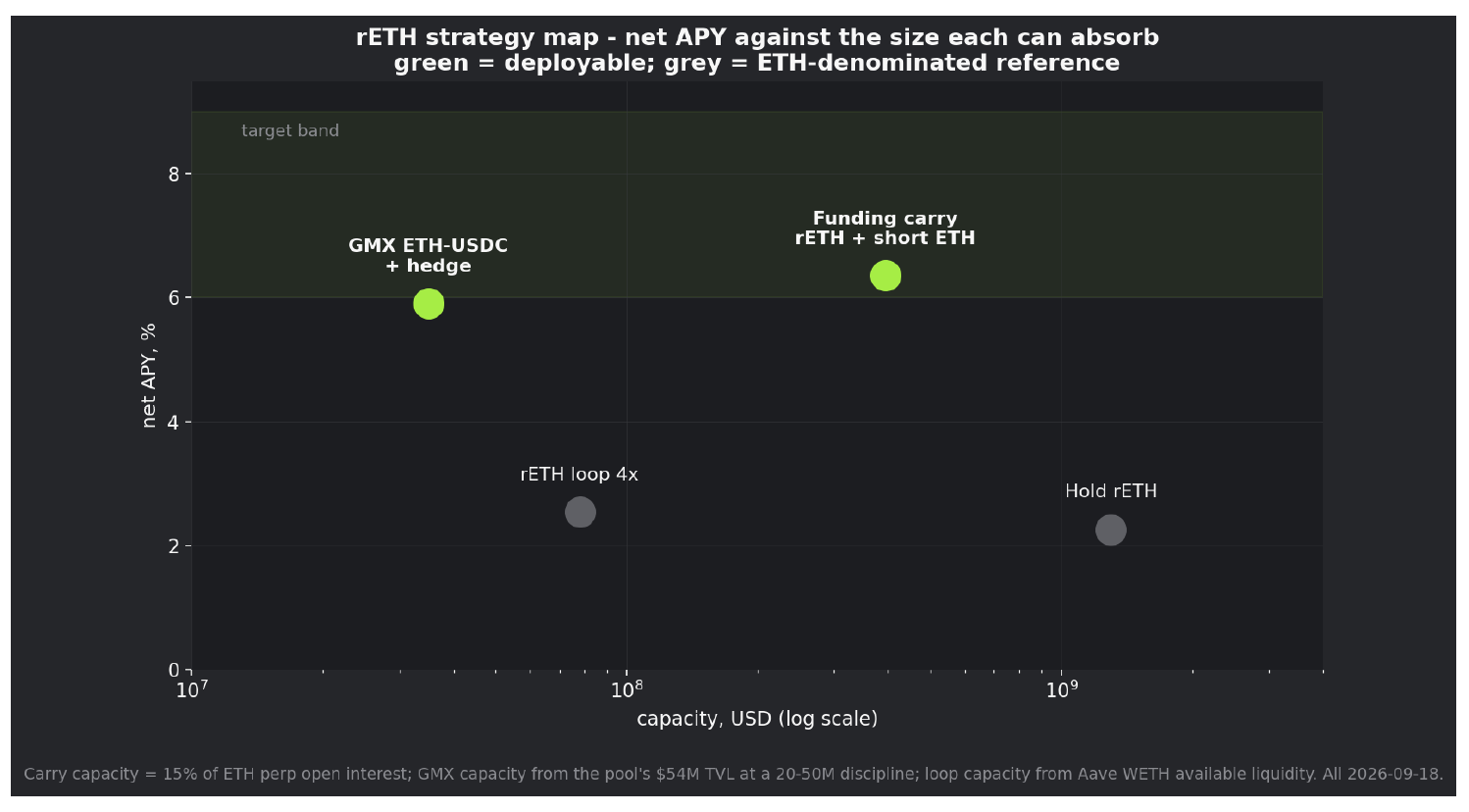
Figure 1 — Net APY vs. capacity each strategy can absorb (log scale). Green = deployable, grey = ETH-denominated reference. Carry capacity is 15% of ETH perp open interest; GMX from the pool’s $54M TVL at a 20–50M discipline.
Every input above was verified against a primary on-chain source rather than a quoted rate:
| Claim | How verified | Result |
|---|---|---|
| rETH yield 2–2.5% | Exchange rate at 366 daily blocks, 2025-09-19 → 2026-09-18 | 2.26% full year; 2.21% trailing 90d; rolling-30d range 2.00–2.90% |
| WETH borrow cost ~2% | currentVariableBorrowRate from the Aave V3 Pool at the same blocks |
2.05% today; 2.10% 90d mean; 2.37% full-year mean; one spike to 9.01% |
| rETH usable as collateral | Aave V3 reserve bitmap + e-mode 1 “ETH correlated” bitmaps | rETH collateral enabled, WETH borrowable, LTV 93% / LT 95% in e-mode |
| Instant redemption liquidity | rocketDepositPool.getExcessBalance() |
0 ETH excess today; deposit pool holds 19.7 ETH |
| Hedge venue depth | Hyperliquid metaAndAssetCtxs |
ETH perp open interest $2.62B |
| Funding is income, not cost | 8,760 hourly prints | +6.17% (365d), +7.86% (90d), +9.70% (30d); 13.9% of days negative |
| rETH trades at a discount | DEX price vs. on-chain rate, 364 daily points | discount on 69% of days; mean −10bp; −16bp today |
Primary strategy — funding carry
The construction is delta-neutral to ETH by design: the long is ETH via rETH, the short is ETH via the perpetual, and both legs are executable from a contract.
hold rETH              2.26% staking yield, accrues in the exchange rate
short ETH perpetual    funding +6.17% over 365 days, paid to the short

hedge ratio = rETH × exchange rate   (1 rETH = 1.172 ETH today; ratio drifts up ~2%/yr)
margin ~25% of notional at 4×        capital = 1.25× the position
There is no gamma; the only rebalancing is the exchange-rate drift plus margin maintenance. The short is re-struck on the exchange rate, not held 1:1, so the hedge stays neutral as rETH accrues.
| Component | 365-day basis | 90-day basis |
|---|---|---|
| rETH staking yield | +2.26% | +2.21% |
| ETH funding received | +6.17% | +7.86% |
| Gross | 8.43% | 10.07% |
| Less round-trip execution | −0.50% | −0.50% |
| Divided by 1.25× capital | — | — |
| Net APY | 6.3% | 7.7% |
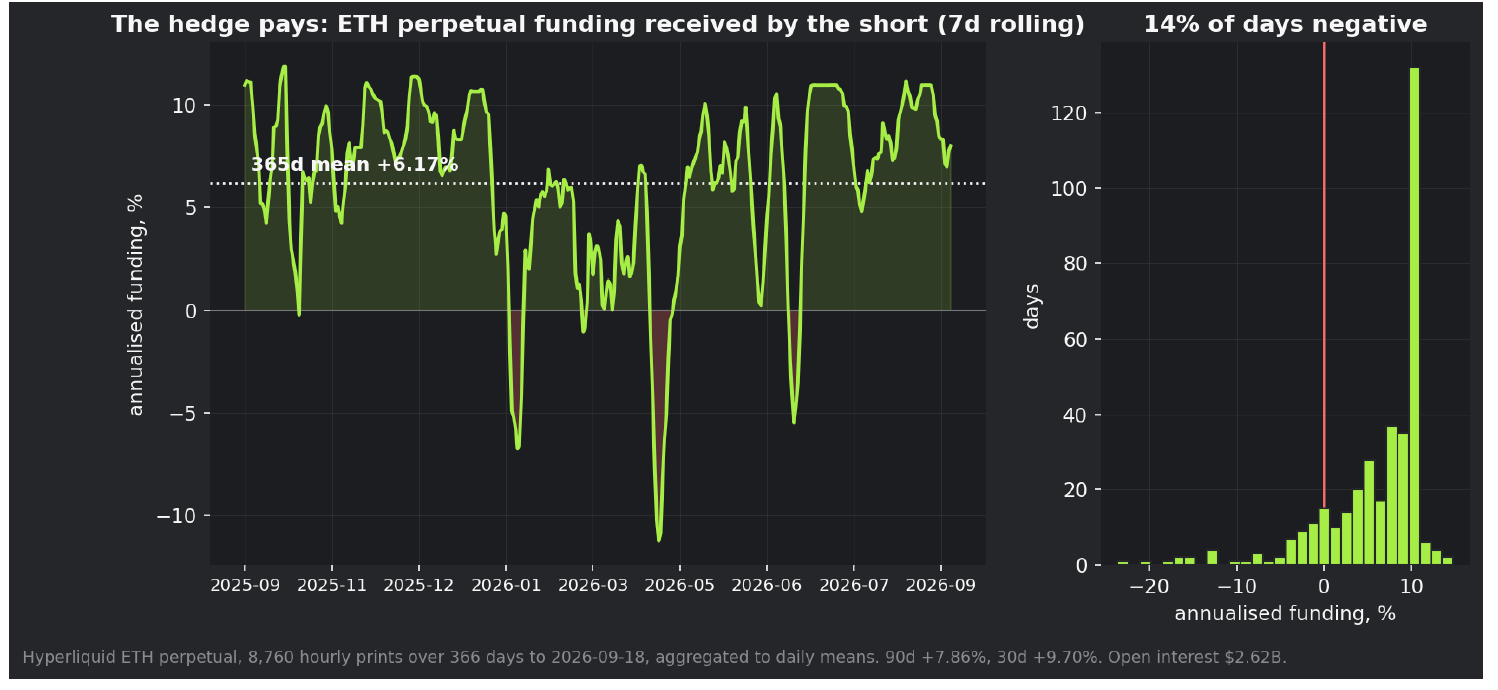
Figure 2 — Hyperliquid ETH perpetual funding, 8,760 hourly prints over 366 days to 2026-09-18. 365d mean +6.17%; negative on only 13.9% of days, and strengthening through the window (30d +9.70%). The 6.3% headline plans against the full-year mean; 7.7% is the current regime.
Capacity is not a constraint. At a 15%-of-open-interest discipline, the hedge supports $390M. On the spot side rETH is a $1.3B token; entry at size is through minting when the deposit pool is open and through DEX otherwise.
Second leg — GMX ETH-USDC + hedge
The same delta-neutral idea applied to a different income source: supply liquidity to the GMX V2 ETH-USDC pool (trading fees, borrowing fees, and the counterparty side of trader PnL) and short ETH against the pool’s measured exposure. The pool’s realised β to ETH is 0.457, not the 0.5 its composition implies; hedging at the measured figure leaves residual β of −0.004 — which is what delta-neutral means in practice. Net 5.9% in the current regime (17.6% full window), sized at $20–50M, sharing the same ETH short as the carry so both legs run on one margin account and one rebalancing loop.
Discount-capture overlay — and why it helps the peg
rETH’s secondary price sits below its redemption value most of the time:
| rETH vs. redemption value (364-day window) | |
|---|---|
| Days at a discount | 69% |
| Mean / median basis | −10.1bp / −8.8bp |
| Days beyond −25bp | 27% |
| Range | −112bp to +166bp |
| Today | −16bp |
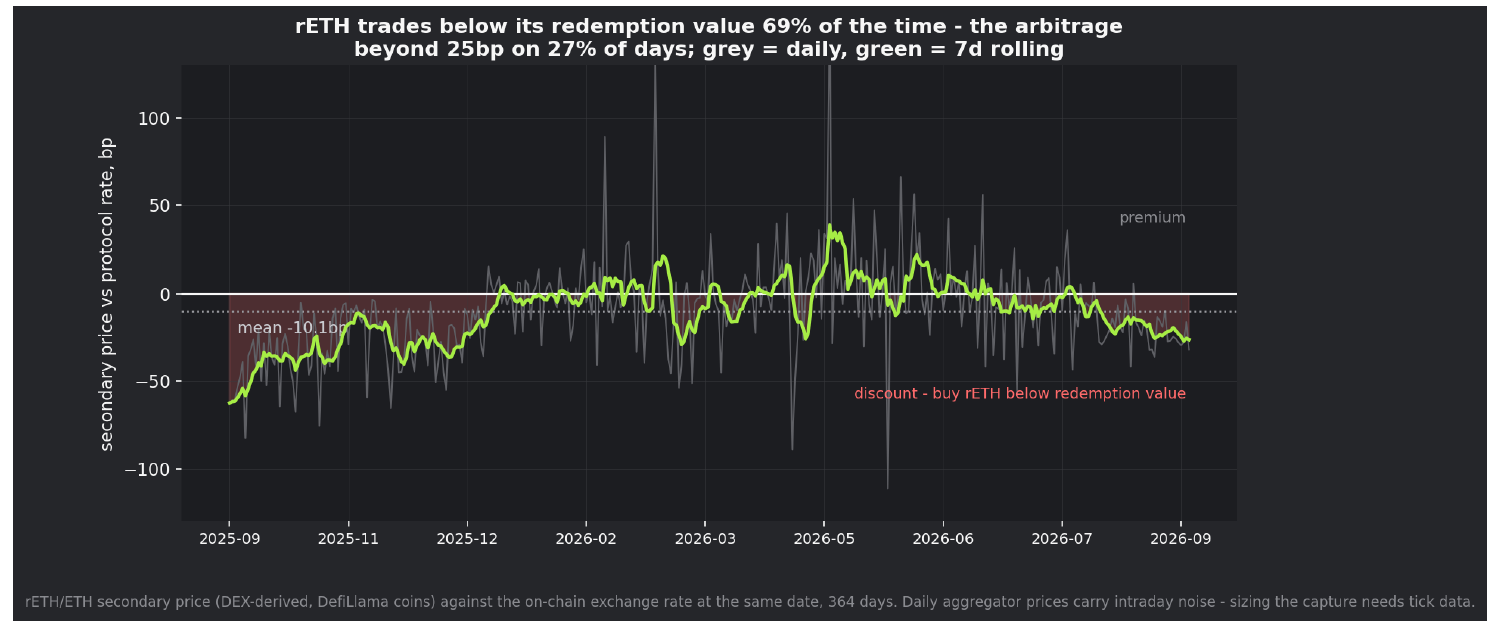
Figure 3 — rETH/ETH secondary price vs. the on-chain exchange rate, 364 days. Grey = daily, green = 7d rolling.
Because ayETH is accumulating rETH anyway, it systematically buys rETH below its exchange rate — a positive-expectation entry that also puts net buy-side pressure behind the rETH peg. Layered onto the carry it plausibly adds 0.5–2%; because daily aggregator prices carry intraday noise, we size the capture with tick-level analysis before any figure enters a forecast. It is an entry-timing overlay, not a standalone strategy.
What we assessed and set aside — looping
We want to be straight about what doesn’t work. rETH looping is mechanically open on Aave V3 (rETH collateral in the “ETH correlated” e-mode at 93% LTV, WETH borrowable at 2.05%, $860M available), but the economics close it:
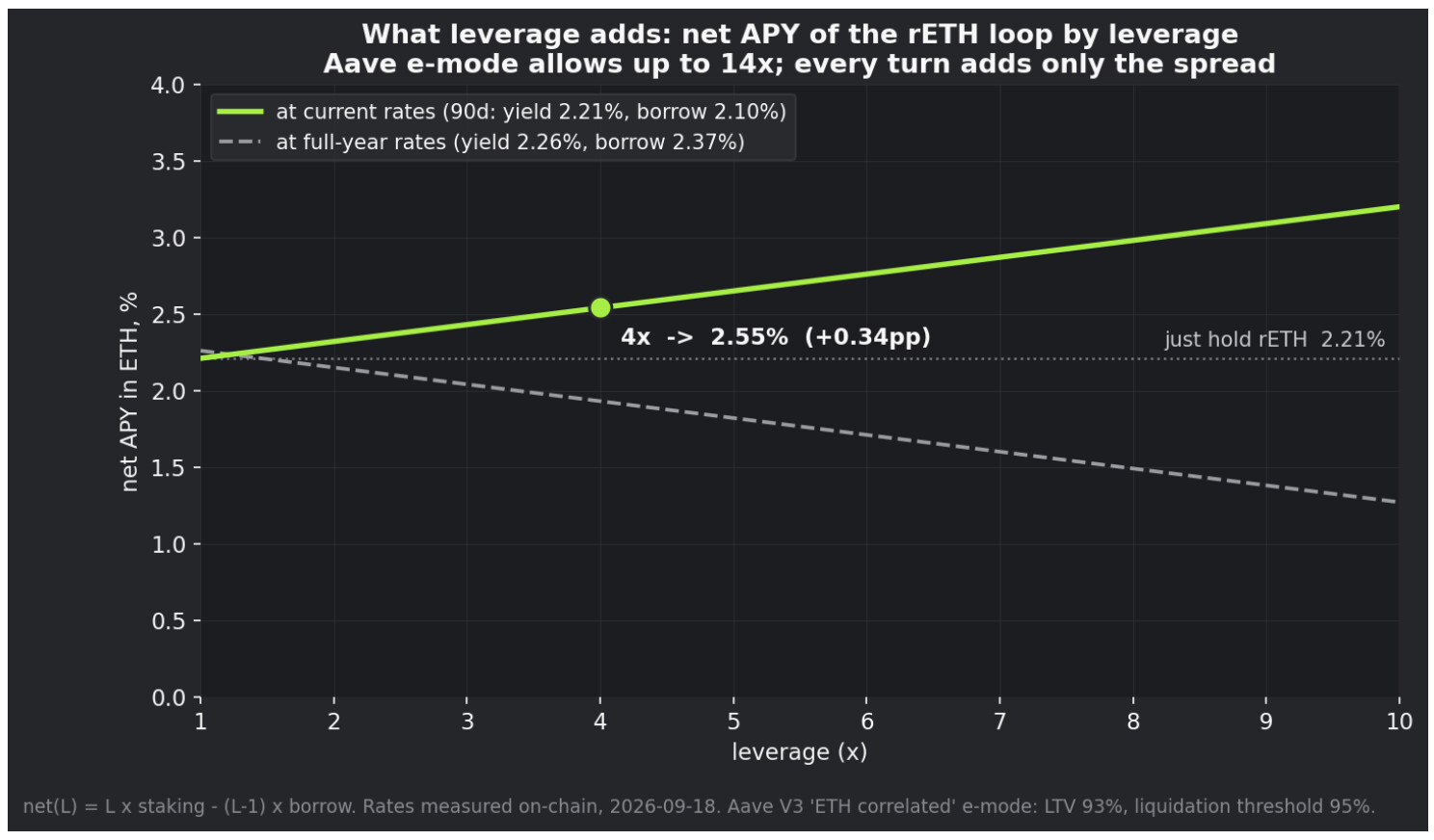
Figure 4 — net(L) = L × staking − (L−1) × borrow. At 4× the loop returns ~2.5% in ETH, +0.3pp over holding rETH, against a 95% liquidation threshold. At full-year rates (2.26% earned vs. 2.37% paid) the spread was negative and the same loop would have cost money.
Leverage multiplies a spread; this one is too thin to multiply. We’d rather show the DAO we ran the numbers and declined than pad the proposal.
Exit path
Instant rETH → ETH redemption depends on the deposit pool holding excess ETH (0 today), so protocol redemption at size waits for inflows. The secondary route is DEX liquidity — ~$8M direct rETH/ETH depth on mainnet plus ~$13.8M in the osETH-rETH Curve pool — so an at-size exit is executed in tranches over a short window. This is automated: DEX in tranches while the discount is narrow, protocol redemption when the pool refills. Operational, not a constraint on the strategy.
Why this is valuable to Rocket Pool
- Net-new, durable rETH demand. ayETH depositors want ETH yield, not ETH beta or staking exposure per se. That broadens rETH’s addressable market to a delta-neutral, USD-return audience it doesn’t currently reach — sticky demand that scales with TVL, not with staking sentiment.
- Buy-side pressure on the discount. The discount-capture entry makes ayETH a structural buyer of rETH when it trades under redemption value — directly supportive of the peg the DAO cares about.
- Multichain reach. Via LayerZero, ayETH carries rETH-backed demand to chains where rETH isn’t natively present, extending Rocket Pool’s footprint without new deployments on your side.
- Transparency by default. APY is computed from on-chain share price, and we’ll publish rETH held via ayETH so the DAO can verify the adoption impact it’s funding.
Risks (and how they’re managed)
| Risk | Status / mitigation |
|---|---|
| Funding regime | The entire variance of the carry leg; 13.9% of days negative, currently strengthening. Sized against the full-year mean, not the current regime. |
| Exit depth | 0 ETH instant redemption today; ~$8M direct DEX depth. Phased, automated exit at size. |
| Cross-venue settlement | rETH on mainnet, hedge on Hyperliquid; margin buffer for transfer latency during fast moves. |
| Hedge-ratio drift | 1 rETH = 1.172 ETH and rising ~2%/yr; the short is re-struck on the exchange rate. |
| GMX pool regime | Trader-PnL share of income is cyclical (2026 YTD 5.9% vs. 30.2% in 2024); sized conservatively at $20–50M. |
Use of funds and commitment
We’re requesting a flat $30,000 grant. It covers the rETH integration engineering (mint/redeem routing, exchange-rate hedge automation, phased-exit logic), an independent review of the rETH-specific code paths, entry/exit liquidity to support at-size deposits and redemptions, and joint education with the Rocket Pool community.
In return we commit to launching ayETH with rETH as its base asset within three weeks of grant approval — a live product, not a research deliverable.
Team
- Filipe Leonor (Founder) — Serial entrepreneur and DeFi investor with over 12 years of team leadership experience; co-founder of Decentralized Foundation, a web3 revenue-share model protocol on Avalanche with a charitable focus. LinkedIn
- Bogdan Ivaniuk (ML/AI Lead) — Co-founder and CEO of AlphaCube, building AI solutions for algorithmic trading. 12 years as a quantitative analyst and AI/ML engineer. LinkedIn
Ask
$30,000 to make rETH the foundation of ayETH, with a three-week launch commitment. Full data, scripts, and charts behind every figure above are available for review. Happy to answer technical questions on the hedge construction, the exit path, or the on-chain methodology here in the thread.
Payment: USDC or ETH on Ethereum mainnet — 0x26992251c55af3e2b541d985cac23369253f3337