Cap USD: Expecting to provide ~3% USD yield based on the Symbiotic rETH vault — currently pending the launch of a new vault and $10M liquidity. In discussion with Gauntlet to resolve.
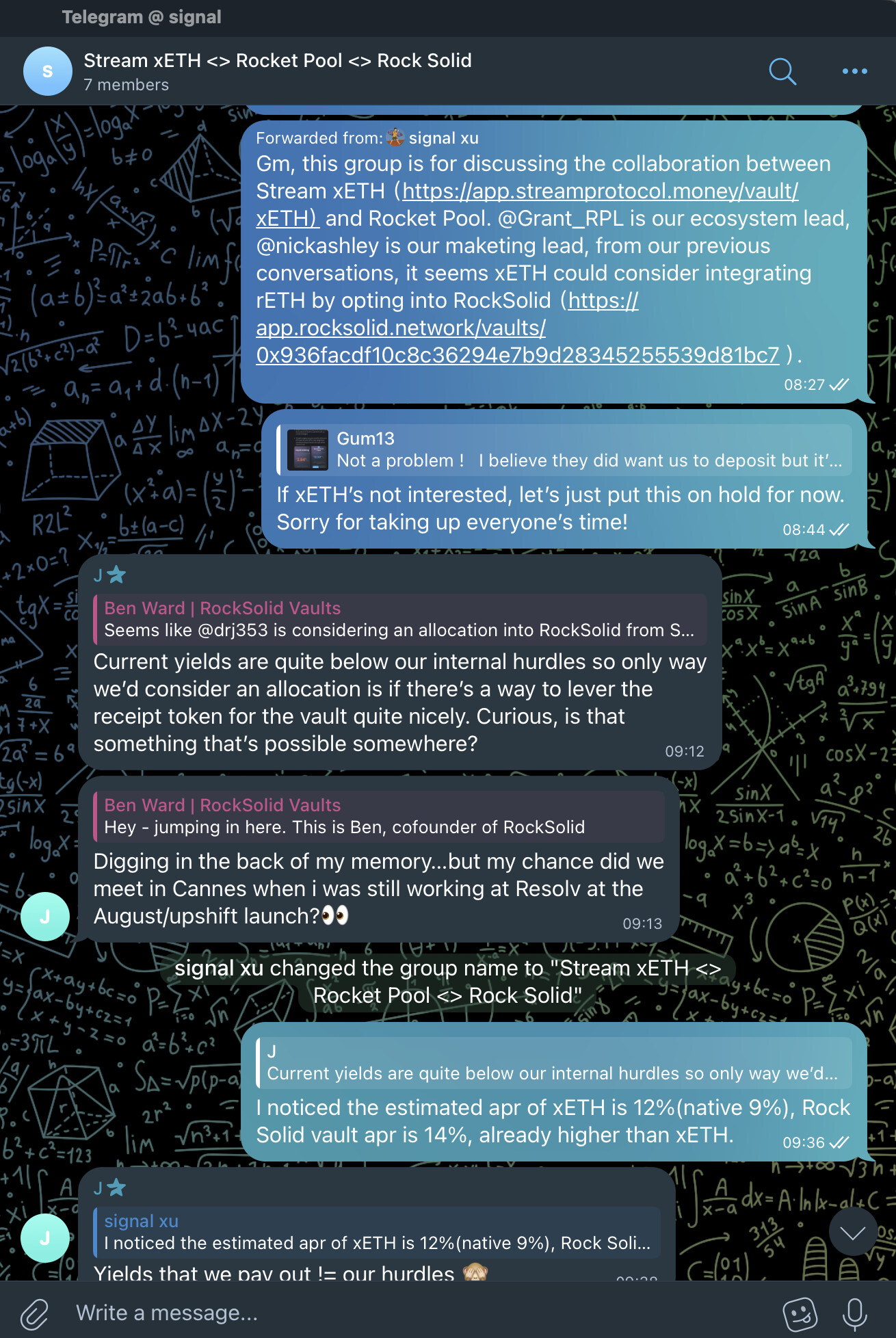
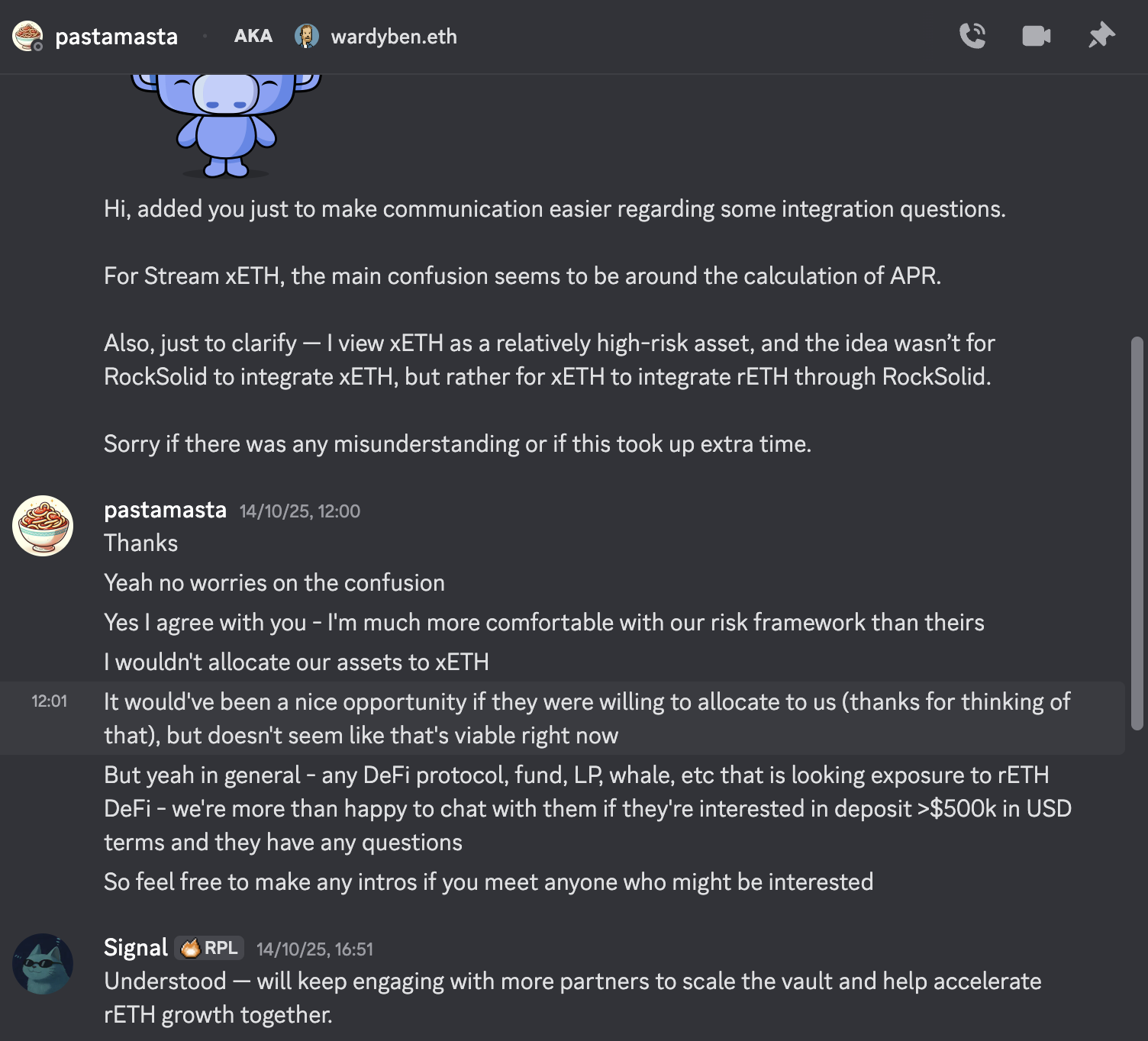
Stream Finance xETH: The goal was for xETH to integrate rETH via the RockSolid vault, but since the current 14% APR doesn’t meet xETH’s 20% requirement, this is now closed.
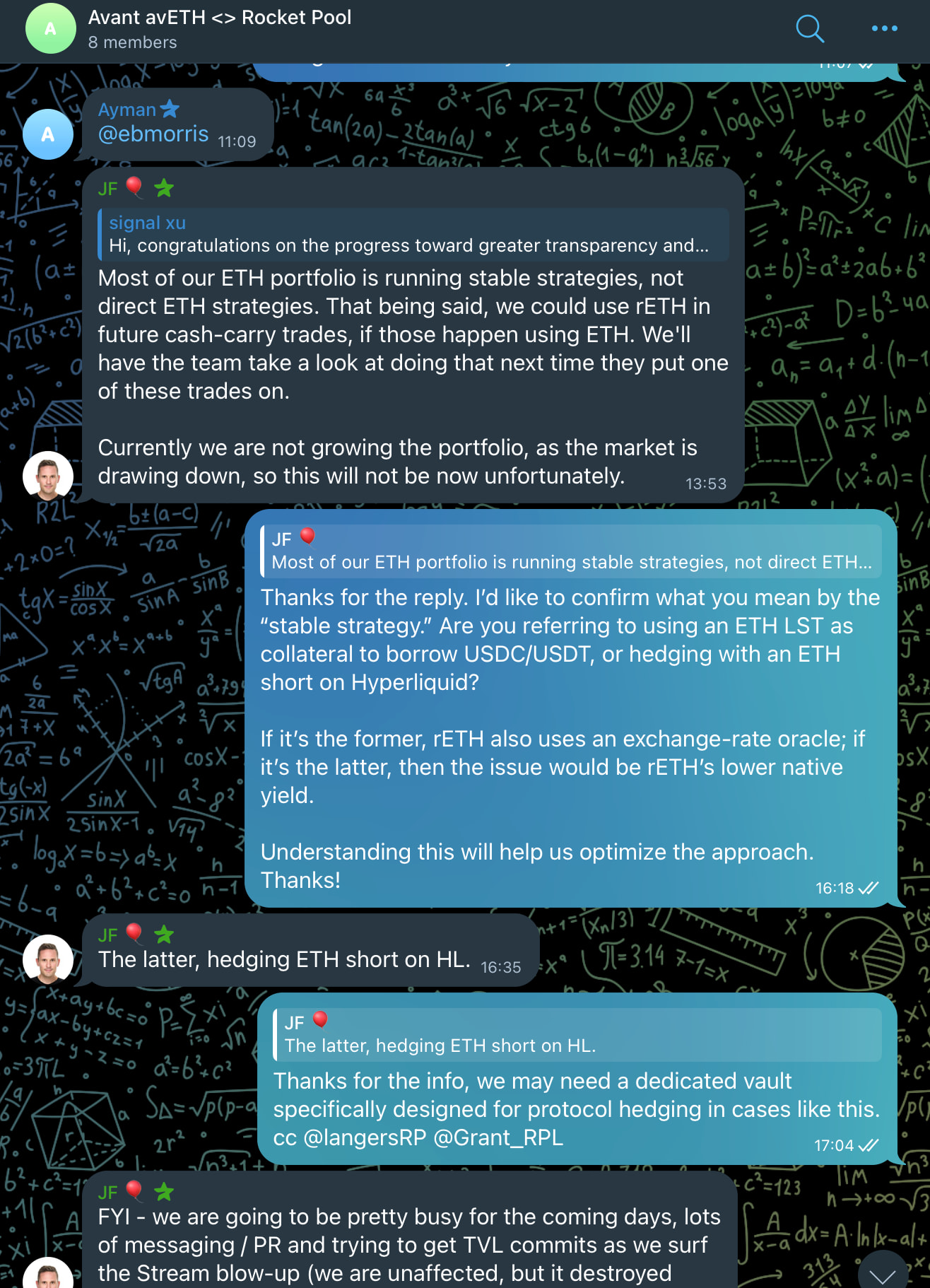
Avant avETH: Established connection and scheduled a meeting next week.
Gauntlet: Ongoing discussions about Symbiotic vault possibilities and corresponding NOs.
Octant: Vault integration with rETH staking confirmed, but pending on specific co-marketing execution. If the team can’t proceed due to constraints, I’ll help promote it within the community to show support.
Kiln: thanks for the @drdoofus reminder. Started connecting with NOs, hoping to bridge via Gauntlet.
Other Updates
Yo yETH: interested in opting into the RockSolid vault, pending APR calculations and integration.
First, a quick clarification regarding Stream Finance. Throughout our collaboration with Stream Finance, the discussion has always been about integrating rETH into xETH — not about RockSolid integrating xETH. During our review of Stream Finance, we also identified that it uses substantial leverage, and we categorized its asset profile as high risk.
Regarding feedback for Rock Solid Vault, two requirements were raised:
APR calculation – this has already been clarified.
Loop support – would like leverage support, such as rETH/rock.rETH market on morpho
In addition, yo protocol has already completed the integration and is currently awaiting allocation.
Fluid
Because of the recent Balancer exploit, Fluid came again to pitch the idea of building liquidity on top of it. However, Fluid itself also experienced an exploit in the past. cc @IMC
Avant
We discussed the possibility of expanding rETH to Avalanche and applying for AVAX grant incentives. In addition, avUSD remained stable during the recent stablecoin deleveraging and currently holds over 35M in ETH exposure, so we also explored the potential for increasing its rETH allocation.
Reserve bsdETH
Due to budget constraints, the team @langers is currently unable to cover the audit costs, so the process is on hold for now. We will consider alternative ways to move it forward, such as leveraging OP’s audit incentive programs.
OP Treasury ETH Liquid Staking RFQ
The information has already been submitted by @maverick . To avoid duplicate submissions, I’ve linked the previous proposal. I will continue to track the progress going forward.
Gnosis LP position was not affected by the Balancer exploit, however, they haven’t added liquidity to the new pool, and their rETH has been swapped for wstETH.
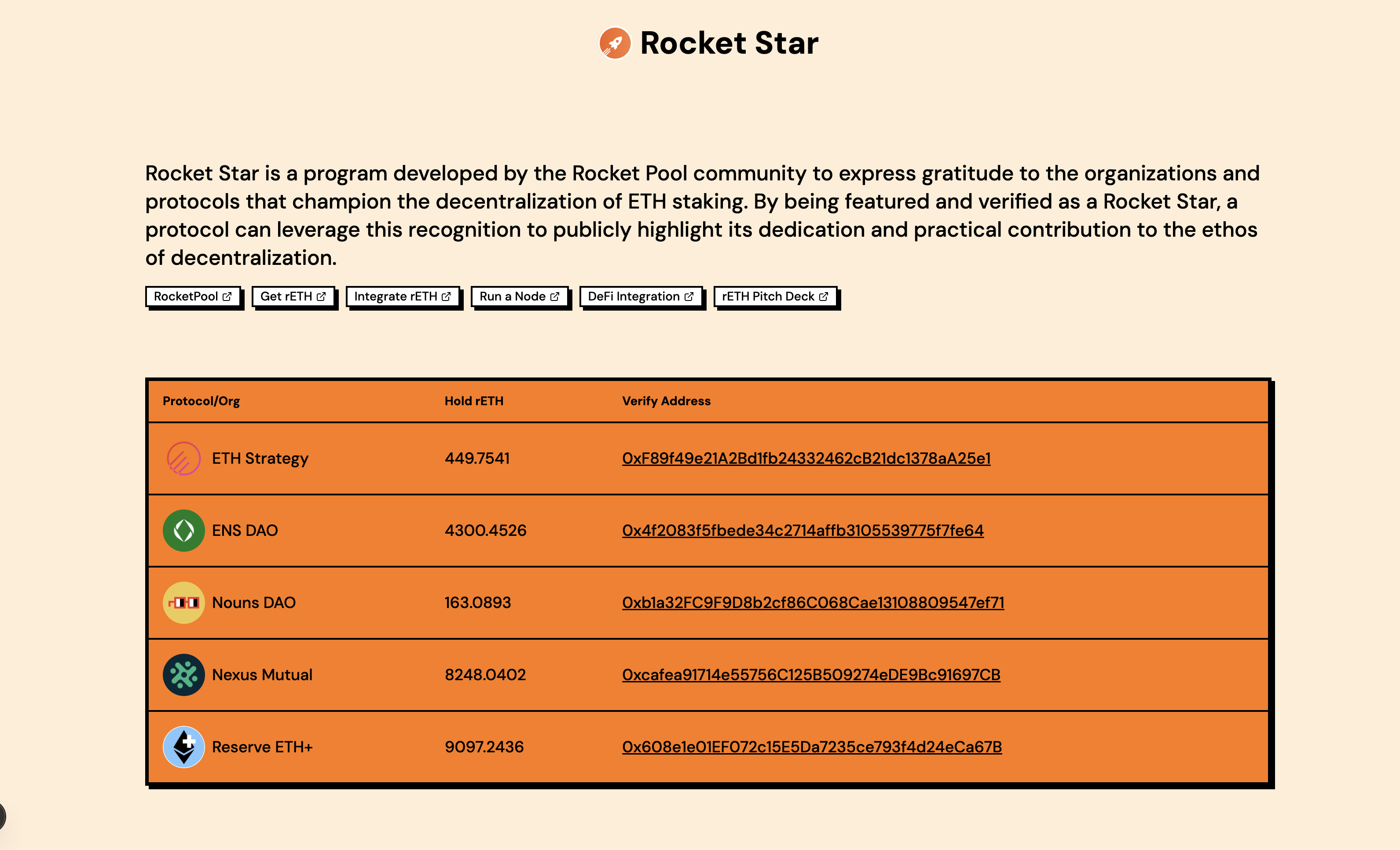
I’ve spent some time building a Rocket Star website that showcases all organizations and protocols holding rETH. The goal is to highlight and appreciate their contributions to decentralized ETH staking, and to give them the recognition they deserve.
I also hope this can help amplify the narrative across social media and the broader community.
If I’ve missed any data, feel free to comment — I’ll gladly update it.
Avant’s avUSD includes an ETH-stable strategy (holding ETH LSTs while opening an ETH short on Hyperliquid), similar to what protocols like Ethena and Resolv use.
However, rETH has generally not been included — most protocols choose weETH or wstETH instead. Compared to those assets, rETH has disadvantages in both yield and peg stability, which makes it less attractive for these delta-neutral or stable-ETH strategies.
If a dedicated vault could be built specifically for rETH — either optimized for higher yield or stronger peg stability — it might help increase rETH’s share in this category of strategies.
The overall DeFi market is currently in a downturn, and the potential collaboration with Terminal on tETH integration into the Ethereal ecosystem has recently been closed. We are now exploring other L1 opportunities.
Since the liquidity is primarily supported externally, the previous sources were mainly Ethereum OGs. Their support was driven by their commitment to Rocket Pool’s decentralization; however, due to market conditions and yield factors, they have now exited:
The exited rETH is being gradually sold off or swapped into wstETH.
Liquidity shortage has now become a challenge for rETH. We have attempted to contact Spark, but they seem to have limited interest; Spark’s liquidity is primarily provided on Curve. A contact group has been established with @maverick .
Prime Asset
rETH is not currently being listed as a prime asset. In fact, there have been ongoing attempts to have Ethena and Resolv adopt rETH as part of their ETH stable strategies, but these have not been successful. For ETH stable strategies, most protocols increase their buying power for ETH and ETH LSTs when the ETH price rises rapidly and steadily, while simultaneously opening ETH short positions on Hyperliquid. However, when the ETH price trends downward—as seen in the past few days—these protocols reduce their ETH positions to mitigate risk by selling ETH and ETH LSTs.
The main reasons rETH hasn’t been included are depegging risks and the lack of a instant withdrawal. This will be addressed in the upcoming RPIP that supports withdrawal.
Furthermore, rETH’s exclusion from prime assets has led to very little exposure in markets like Morpho. Currently, rETH is only listed on Morpho Base and is absent from other chains.
Discussions with curators like Gauntlet indicate that this is mainly due to liquidity and peg stability; rETH is perceived as weaker in these areas compared to stETH and weETH (which supports instant withdrawals). WBETH is primarily supported as collateral on Binance.
Institutional lending protocols are a direction I am personally optimistic about. Maple’s growth over the past year suggests this is a viable path. Morpho and Aave are not particularly friendly to institutions due to their variable borrowing rates and unstable liquidity. In contrast, institutional-facing lending protocols solve this by providing fixed rates and ample liquidity. Some researched institutional lending protocols include:
Outreach for this sector is primarily via B2B emails, which are permissioned and require verification. The core team may need to submit some contact forms and collaborate on the follow-up. Furthermore, this could serve as a benefit for institutional adoption of rETH. cc @langers@maverick
Other Protocols
MakinaFi: A new protocol, but a recent exploit occurred; no further progress for now.
Aave V4: Expected to launch this year. Unsure if a previous contact group exists; currently trying to reach out to TokenLogic to understand and move this forward.
ETHGas: Requires verification; the contact form has been forwarded to @maverick .
We’ve established contact with them. Currently, they don’t have a strict list of requirements because their approach is very demand-driven.Their main focus is the borrowing amount. Essentially, as long as there are institutions holding rETH who want to use it for borrowing, they can structure a deal. cc @langers@maverick
EF Staking
Noticed that the Ethereum Foundation (EF) recently staked a large amount (2048 ETH), but they bypassed LST protocols entirely.
Furthermore, both Lido and StakeWise are now pushing Vault solutions specifically to capture this type of institutional/foundation staking. This is a trend we should keep an eye on.
OP Grant Season 9
OP Grant Season 9 applications are officially open. We are currently preparing our proposal with a focus on boosting rETH liquidity on Superchain.
Deal Pipeline (Excluding inactive ones; current Pending list)
Reserve (bsdETH Integration): This is currently pending due to audit budget, will try to use OP audit grant to cover it.
Cap USD: Regarding the Symbiotic Vault, the main blocker is that we lack a Curator to push user to migrate the $19M to a new vault to enable Cap restaking.
This month, the focus was on reaching out to and learning about several upgraded DeFi protocols, including Aave v4, Moonwell mainnet, Alchemix v3, and Silo v3. I also contacted Jumper to look into the Earn integration for rETH.
Aave v4
Aave v4 just launched, and we already knew that rETH wasn’t on the initial asset list. Integrating rETH into Aave v4 involves two parts: adding rETH to the Core Hub, and adding a Rocket Pool Spoke to support rETH/ETH pairs (similar to eMode in v3). The proposal I’m preparing only covers rETH. If we want to add RPL, we could potentially add it to the Rocket Pool Spoke to support rETH and ETH/RPL lending, but RPL still wouldn’t be used as collateral.
Given RPL’s current liquidity, if we want to build a lending pair for RPL and ETH, Silo v3 might be a better fit. Silo v3 supports a mechanism where, if the collateral’s liquidity is insufficient during liquidation, it gets distributed directly to the lenders.
Moonwell Mainnet
Moonwell is about to launch on Mainnet, and we are looking to add an rETH market.
The proposals for both Aave and Moonwell are currently waiting for @maverick’s review. Once reviewed, they will be submitted to their respective forums.
Alchemix v3
Alchemix v3 will support higher LTV, which can further improve capital efficiency. After talking with their team, they’re hoping rETH will support the active unstaking feature. @maverick will continue these discussions in person at ETHCC.
Jumper Earn
For the Jumper Earn integration, they are looking for some referral rewards. If the Rocksolid vault has a similar mechanism, we can help make an introduction. @paladin147
Following up on the previous post, here are the latest updates across protocols:
Aave v4: Proposal has been officially submitted to the Aave forum.
Moonwell: Submitted the proposal along with risk parameters; currently awaiting the next steps for deployment.
Silo: Established contact with their core team. We are preparing to submit market parameters for pairs including RPL/ETH and rETH/ETH (Spark Lend has delisted rETH, we need a high LTV market for the leverage staking).
The rsETH incident has significantly impacted the LST/LRT landscape, triggering a massive exit from leveraged staking positions in Lido and EtherFi. This presents a strategic window to re-pitch rETH to various organizations, encouraging them to re-evaluate and integrate rETH.
Following up the problem of the rETH/ETH Chainlink feed and its potential influence on the Reserve ETH+.
On the GMC Townhall, we had also just discussed that the rsETH incident was a good opportunity for marketing. Not in the cynical way of using a horrible event for our benefit, but rather reminding people that rETH is not rsETH and that it is a stable, safe and trusted token, i.e. a responsible part of a diversified portfolio. Nothing fancy like all this restaking, 500% yield, infinite looping sort of DeFi craziness. We’re not oreo-flavored super sour neon nerd gummies with Flaming Hot Ginger Mountain Dew, we’re Worther’s Original with tea. Anyway, you get the point.
I agree that it is an opportunity to remind people that we are here, that all DeFi is not max risk insanity, and that diversifying is investing and not diversifying is gambling.
ETH+ has been gradually rotating out of rETH. We had several detailed conversations with the team, but the key concerns remain liquidity depth and APR. At the moment, we have not been able to fully convince them to maintain or increase rETH exposure under current market conditions.
Moonwell mainnet is now live. For the proposal to add rETH to the market, I have provided additional responses and supporting context where needed.
For Silo, the RPL/ETH and rETH/ETH markets will likely need to be launched by us directly. RockSolid has not shown interest in supporting a rock.rETH/ETH lending pair for now.
Market Observations
Across the market, the main ETH and LST-related strategies I am seeing are:
Aave + Ethena style growth: Aave has been using committed TVL to apply for incentives in new markets, while Ethena contributes liquidity and helps drive TVL through stablecoin looping. In the previous Aave liquidity stress event, the bigger impact was not mainly in the ETH market, but in stablecoin looping. Some stablecoin yield protocols are also building on top of this structure, which helps maintain scale and growth.
Binance wbETH: wbETH previously grew quickly, but after the large-scale liquidation event around October 10, 2025, growth appears to have stalled. One observable use case is that wbETH can be used as collateral for perp, enabling ETH-related trading strategies.
ETH-neutral strategies: Users short ETH on Hyperliquid while holding ETH LSTs, capturing both funding rate and staking yield.
ETH long/short strategies: Lending markets are used to go long or short ETH, with ETH LSTs adding incremental yield.
ETH staking looping: Users deposit ETH LSTs, borrow ETH, swap ETH back into ETH LSTs, and repeat the loop.
ETH carry trades: Users deposit rETH, borrow USDC, and use the USDC to farm higher-yield opportunities, mainly capturing the USD rate differential.
Current Challenges
The current Aave ETH borrow rate is around 2.1%, while rETH APR is around 2.06%. This means ETH staking looping is no longer attractive using rETH. Combined with weaker exit depth and lower APR, rETH is facing pressure as a preferred asset for these strategies.
As the market continues to trend downward, incentive efficiency on new L1s and L2s is also declining. Because of this, it may be difficult for RockSolid + Rocket Pool to replicate the Aave + Ethena growth model in the current environment.
There also appear to be fewer emerging DeFi protocols with meaningful ETH-related demand. The fastest-growing one I have seen recently is STRCFi, but recent STRC price volatility has caused related stablecoins to depeg. Beyond that, I have not seen many new ETH-focused protocols that look immediately relevant for rETH integrations.